
.jpg)
Rufus mediated 15–20% of mobile queries on Amazon in 2025 and drove $12 billion in incremental sales. Products surfaced through Rufus see 3–5× the click-through rate of standard organic results, and shoppers who engage with it purchase 2.74× more than those who don't. Listings missing from its answers are losing the fastest-growing surface on the platform.
Rufus optimization is a structural rewrite of how your catalog presents itself, not a content refresh. The brands winning here treat their listings as inputs to an AI assistant — not a keyword index.
What Is Amazon Rufus?
Rufus is Amazon's conversational shopping AI. It reads your full product detail page, A+ content, customer reviews, Q&A, and product images (via optical character recognition) to answer shopper questions and recommend products. Launched in early 2024 with 100M users, it crossed 250M shoppers by early 2026, and monthly active users grew 140% year over year.
Under the hood, Rufus combines agentic AI capabilities, custom-built shopping language models, and retrieval-augmented generation (RAG) across multiple data sources. The output is personalized recommendations based on shopper intent, not the keywords they typed.
The Three-Layer Search Stack
Rufus sits on top of Amazon's existing search infrastructure rather than replacing it. Three layers work together to produce a ranked answer:
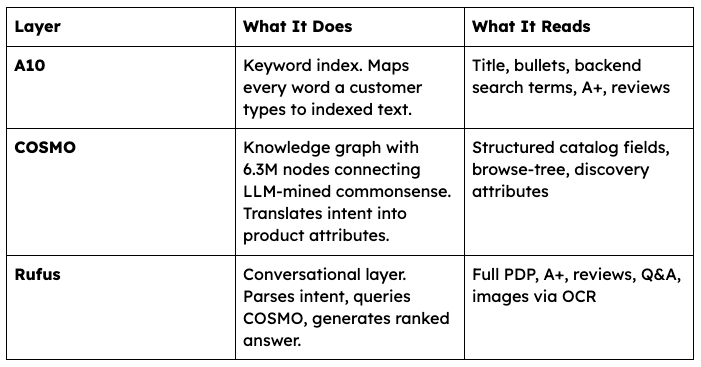
A shopper types "running shoes for flat feet under $100." Rufus parses the intent. COSMO traverses the graph: arch-support → motion-control → price → review-quality. A10 handles keyword matching and conversion velocity weighting. The three layers compose into a single ranked answer set.
Optimize for one and you starve the other two.
How Rufus Works in Practice
A shopper asks Rufus "how do I freshen a closet?" instead of typing "air freshener." Rufus identifies the underlying intent — odor control in an enclosed space — and looks for listings that match the use case. The recommendations include cedar rings, activated charcoal bags, and sachets. Each one surfaces because its listing explains the scenario, not just the product category.
When the shopper taps a product, Rufus generates follow-up questions: how long does it last, how to recharge the scent, how many bags are included. Each answer pulls from the listing itself. A vague listing leaves Rufus guessing, and Rufus does not recommend products it isn't confident about.
Rufus vs. Traditional Search — The Performance Gap

The gap explains why Rufus optimization moved from "interesting trend" to ranking priority inside one year.
How To Get Your Listings Featured in Rufus
Five elements drive whether Rufus features your product:
- Contextual understanding — Semantic phrases, scenario-driven language, and use-case framing tell Rufus when to surface your listing for conversational queries.
- Consumer behavior signals — Rufus weights seasonal and event-driven shifts (Black Friday, back-to-school, holiday décor), so listings tied to current shopping behavior get prioritized.
- Structured attributes — Color, size, material, certifications, and other discovery attributes feed COSMO directly. Most sellers fill five bullets and leave 30+ structured fields blank. This is the single highest-leverage gap in most catalogs.
- Performance signals — Click-through rate, conversion rate, customer reviews, and return rate all feed back into whether Rufus recommends you again.
- Cross-surface consistency — Rufus evaluates consistency across title, bullets, A+ content, and Brand Store. Contradictions hurt ranking.
The Frameworks That Get You Featured
The "Why This Product" Paragraph
The single highest-impact tactic in Rufus optimization comes from indexing one sentence across three anchor locations: title, bullet 1, and A+ module 1. Rufus quotes this paragraph verbatim in its answers when it surfaces your product.
Write one tight sentence that explains why this product solves this specific use case. Repeat it consistently across the three locations. Rufus and COSMO both reward consistency.
The Title Formula
Amazon's mobile cutoff at 80 characters defines where ~70% of shoppers stop reading. Use this structure:
Brand · Type · 1–2 keywords · benefit · variant — under 80 characters.
Keep total title length under 180 characters. Keyword-stuffed titles past 200 characters drop click-through rate by 12–18% and trigger suppression risk. The 2026 system rewards blurb-style titles over keyword lists.
The Five-Bullet Pattern
Bullets carry conversion weight and feed Rufus the context it needs to answer follow-up questions. Structure them in this order:
- Hero benefit — the one-sentence "why this product."
- Use case — explicit "for X, when Y" scenario.
- Differentiator — what makes this not the cheap option.
- Specs and compatibility — the search-anchored facts.
- Trust and warranty — risk-reduction copy.
Every bullet should pass the "for X, when Y" test. A bullet that fails the test is feature copy, not benefit copy — and Rufus penalizes feature copy because it can't tell which shopper question your product actually answers.
Sponsored Prompts — The Paid Placement Inside Rufus
Sponsored Prompts went generally available March 25, 2026, as paid placement directly inside Rufus chat. Brand-registered sellers are auto-enrolled and the format is CPC-charged. Many sellers are paying for Rufus placements without realizing it.
Sponsored Prompts convert best on AI-generated compatibility questions ("Does it fit X brand?", "Will this work with Y?"). General brand-awareness questions burn spend. Audit your Sponsored Prompts activity in the ads console and negative-target the broad brand queries that aren't driving orders.
How To Make Your Listings Rufus-Ready
Rufus-ready content reads naturally, contains accurate structured data, and aligns across every customer-facing surface. The concrete moves that work:
- Run keyword research with natural language in mind. Long-tail, question-based, and problem-solving queries reflect how shoppers actually talk to Rufus. Mine Amazon autocomplete, competitor reviews, Q&A sections, and your Search Query Performance dashboard for the exact phrasing customers use.
- Bake benefit copy into your images. Rufus reads product images via OCR, so text on infographics, lifestyle shots, and comparison images now feeds the ranking signal. Most sellers leave this on the table.
- Unlock A+ Premium. Premium A+ opened to non-vendor brands in 2025 (was $250K–$500K per year; now free for brands submitting 5+ A+ projects per 12 months). It drives 15–20% conversion lift vs. Basic A+'s 5–10%, and it feeds Rufus structured brand data through comparison modules and interactive hotspots.
- Complete every structured catalog attribute. Discovery attributes, flat-file fields, and browse-tree placement feed COSMO directly. Five well-written bullets won't compensate for 30 empty attribute fields.
- Maintain consistency across PDP, A+, and Brand Store. Rufus checks for contradictions. A listing claiming "stainless steel" in the title and "aluminum" in the A+ comparison module loses ranking.
- Optimize the backend search field carefully. The cap is 249.5 bytes (not characters — accented letters and em-dashes cost 2–4 bytes each). Use space separation, no commas, no repeats from the title, no brand names, no ASINs. Exceeding the cap by one byte causes Amazon to silently drop the entire field.
How To Test Whether You're in Rufus Answers
Open Amazon on mobile. Type your top five organic search queries into Rufus directly. If your product is missing from the answer, your listing is answering the wrong question.
Run this test monthly. Track Rufus share of voice the same way you track keyword rank — ranking on page one of organic search doesn't help you if Rufus has already surfaced three competitors above the fold.
Frequently Asked Questions
Does Rufus replace traditional Amazon SEO?
No. Rufus sits on top of A10 and COSMO. Keyword indexing still determines whether you're eligible to appear, and Rufus determines how you're framed in the answer. Both layers matter, and optimizing for only one starves the other.
How do I check if my listings appear in Rufus?
Test directly. Type your top organic search queries into Rufus on the Amazon mobile app and look for your products in the response. Repeat the test monthly to track changes.
What is Sponsored Prompts?
Paid CPC placement inside Rufus chat, launched March 25, 2026. Brand-registered sellers are auto-enrolled. Compatibility-style prompts convert best; general brand-awareness prompts burn spend. Audit and negative-target accordingly.
Will keyword stuffing help me appear in Rufus?
The opposite. Keyword-stuffed titles past 200 characters drop click-through rate by 12–18% and trigger suppression. Rufus rewards contextual, use-case-rich copy.
How much of Amazon traffic does Rufus actually handle?
Rufus mediates 15–20% of mobile queries as of Q1 2026, and the share grows every quarter. Amazon attributed $12B in incremental sales to Rufus in 2025.
Ready To Audit Your Rufus Performance?
Brightshift will test your top 10 organic queries against Rufus and show you exactly where your listings are missing — plus the structural changes that close the gap. Book a free 30-minute Rufus audit.

.svg)


