
.jpg)
If you're spending $10,000/day on Facebook and you can't estimate how much of that is driving Amazon revenue, you don't actually know your ROAS.
Here's the framework we use. No expensive attribution tools. No holdout tests. Just Search Query Performance data and basic hypothesis testing.
What the Halo Effect Actually Is
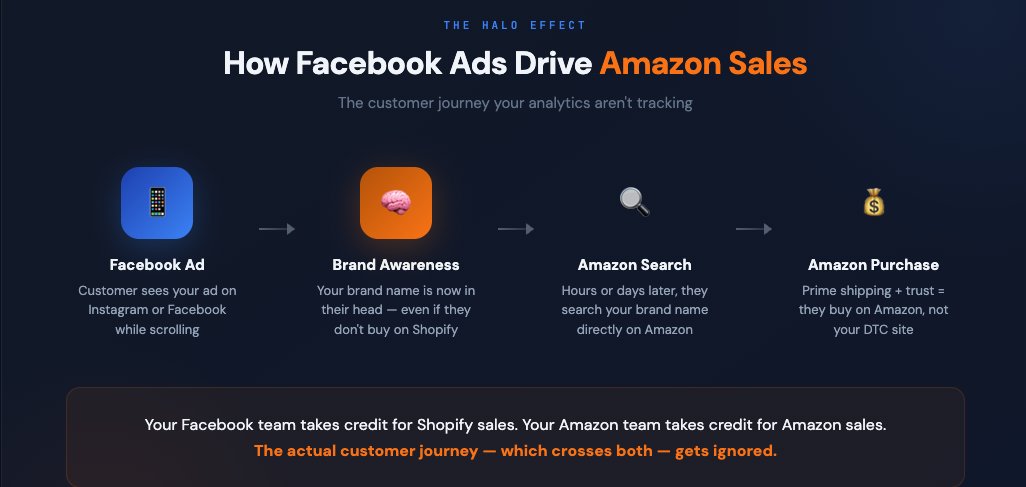
The Halo Effect is simple: you generate brand awareness off of Amazon, and then people type your brand name into Amazon's search bar.
Customer scrolls Instagram. Sees your ad. Clicks through to Shopify. Maybe doesn't trust your shipping settings. Goes to Amazon and searches your brand name. They buy there instead because Prime gets it to them tomorrow.
We manage multiple brands spending $10K-$30K/day on Facebook. Their branded search volume on Amazon? 10,000-20,000 searches per month.
When Facebook spend moves, branded search moves with it.
The Framework: One Input, Two Outputs
Here's the mental model:
Input: Facebook ad spend
Output 1: Branded search volume on Amazon
Output 2: Branded sales on Amazon
Step 1: First Understand that not all Amazon Revenue is Created Equal!
Your total Amazon revenue is a mix of two types of sales:
Generic sales — someone searches "body soap" and buys your product. They didn't know your brand. Amazon's search engine and your listing did the work.
Branded sales — someone searches "Dr. Squatch" and buys your product. They already knew your brand. Something off-Amazon put your name in their head.
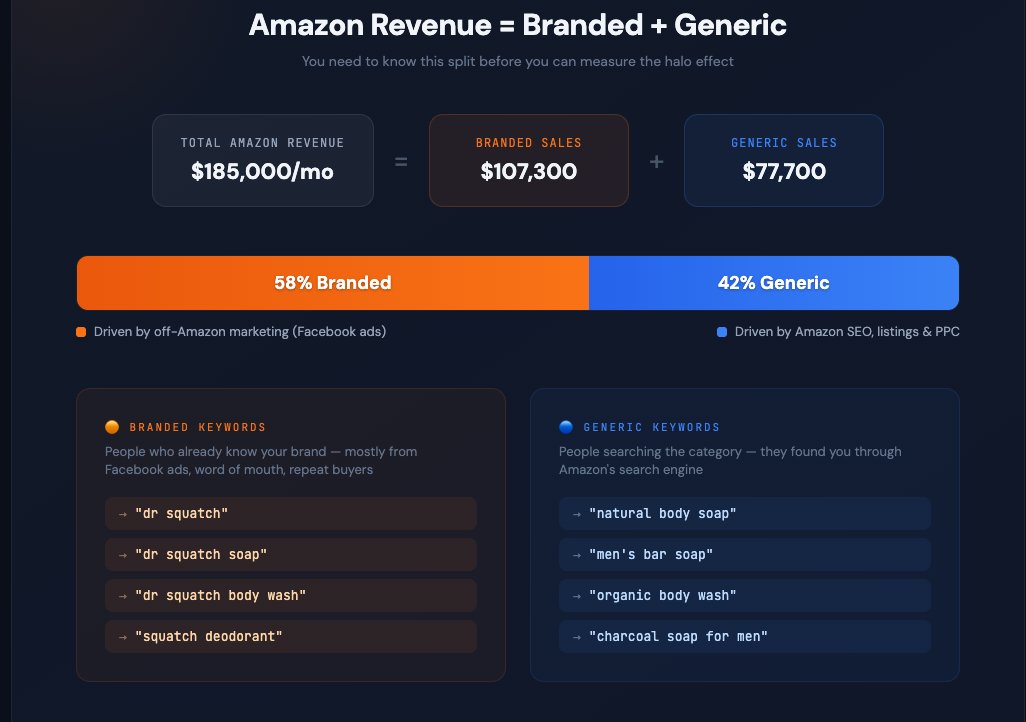
You need to know this split. And you get it from Search Query Performance reports.
SQP shows you purchases on a per-keyword basis. Pull the report, categorize every keyword as branded or generic, and calculate the percentage.
If 90% of your Amazon purchases come from branded search, your Amazon business is basically a conversion engine for your Facebook ads. If it's 50%, Amazon is more self-sustaining through organic ranking.
Why this matters: Facebook ad spend should influence branded purchases but NOT generic keyword purchases.
Generic sales come from Amazon SEO, listing quality, and Amazon PPC. Branded sales come from people who already know your name — and that's mostly your off-Amazon marketing.
Step 2: Correlate Facebook spend to branded search volume
Now you need 52 weeks of data. Seriously — pull a full year.
Export your weekly branded search volume from SQP. Export your weekly Facebook ad spend for the same period. Plot them against each other.
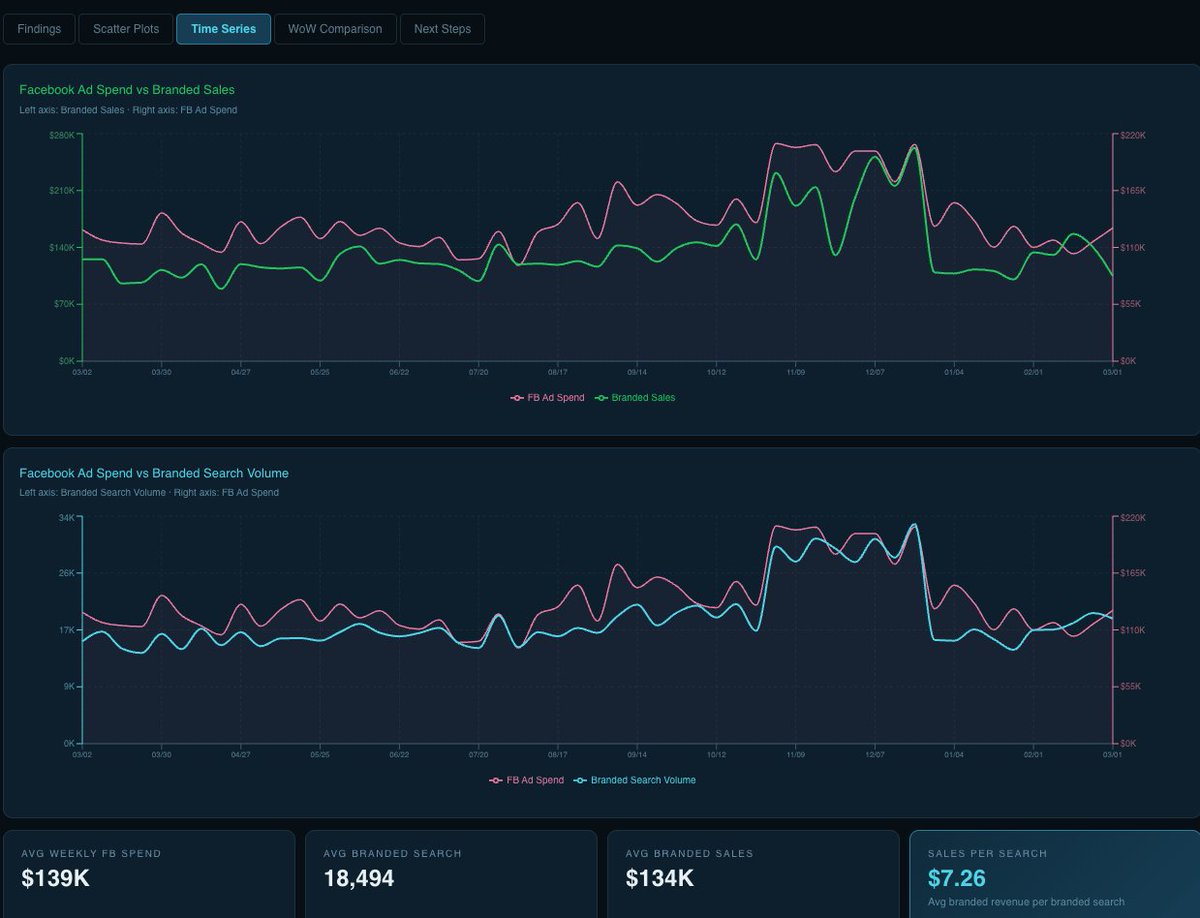
What you're looking for: when Facebook spend goes up, does branded search on Amazon go up? When Facebook spend drops, does branded search drop?
For most DTC brands, the correlation is strong and obvious. You don't need a statistics degree to see it.
Now here's the important part: look for natural variations. Did you scale Facebook spend for a product launch in March? What happened to Amazon branded search that same week? Did you pull back spend in July? Did branded search dip?
These natural fluctuations in your data are essentially mini-holdout tests.
You didn't run them on purpose, but they happened and they tell you the relationship between your Facebook spend and your Amazon branded search.
One thing to watch for: exclude anomalies on the Amazon side. If your listing got pulled down for two weeks. If Seller Support suspended your account. If you ran out of inventory. Those data points will throw off the correlation because something OTHER than Facebook spend caused the change. Exclude them.
Step 3: Connect it to revenue
Now you have:
- The correlation between Facebook spend and branded search volume
- The percentage of Amazon revenue that comes from branded searches (from Step 1)
- Your branded search conversion rate (also from SQP)
Multiply them together.
Example: Every $1,000/day increase in Facebook spend → 200 additional branded searches per week on Amazon Branded search conversion rate → 12% Average order value → $45
That's: $1,000/day more on FB → 200 searches → 24 purchases → $1,080/week in Amazon revenue → roughly $500/day.
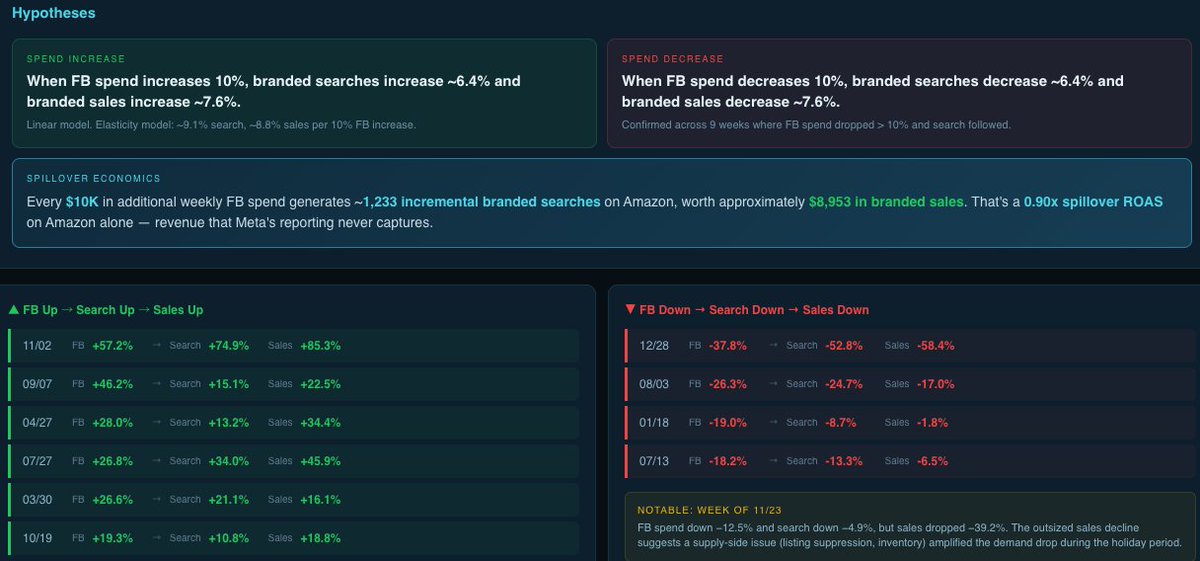
Now you have a working hypothesis:
"If I increase Facebook spend by $1,000/day, Amazon branded sales will increase by approximately $500/day."
That's your halo effect, quantified.

The Gold Standard vs. The Practical Approach
The absolute best way to measure the halo effect is a holdout test. You drop Facebook spend by 30%, change nothing on Amazon, and measure exactly how much branded search and branded sales change.
That's clean and definitive. But do you want to lose 30% of your Facebook traffic for a 2 week test?
The framework I just described gives you the same directional answer by mining the natural variation in your own historical data. Is it as precise as a controlled holdout test? No. Is it directionally accurate and actionable? Absolutely.
Now why does this matter? This means you can actually outspend your competitors.
If your competitor thinks their Facebook ROAS is 1.1x based on Shopify revenue alone, and you know your TRUE ROAS is 1.9x because you're counting the Amazon halo — you can afford to spend more on Facebook than they can.
You can bid higher. You can scale harder. You can acquire customers that your competitor thinks are unprofitable because they're not measuring the full picture.
Why Most Amazon Agencies Can't Do This
This analysis requires two things most agencies don't have:
- Communication with your paid social team (or at least access to your Facebook spend data)
- The ability to actually analyze Search Query Performance reports
Over the past year, I have interviewed over a thousand people for brand manager positions. My number one filter question is about SQP analysis. 95% can't do it. That's not an exaggeration.
Most agencies treat Amazon as an island. They optimize PPC, tweak listings, manage inventory. But they never ask the fundamental question: where are these customers actually coming from?
If your Amazon agency doesn't understand how DTC brands operate and where Amazon exists in your holistic marketing architecture, they're not the right partner for you.
The Bottom Line
It's not Amazon vs DTC - it's about what generates the most contribution margin and net profit at the end of the day.
Measure the halo. Quantify it. Use it to outspend your competition.
The data is sitting right there in Search Query Performance reports. Most people just don't know how to use it.
We do this analysis for every DTC client spending heavily on Facebook. If you want an Amazon agency that understands where Amazon fits into your omni-channel strategy, book a call.

.svg)


